My parents were adamant that my niece should reside with them. However, the hospital's protocols indicated a different course of action. A single scan of Lizzy’s identification band triggered a security notification, a confirmation bearing my name, and a disclosure of information they had concealed for a considerable period.
I discovered my eight-year-old niece, Lizzy, locked in my parents' closet and immediately took her to the emergency room. There, a scan of her hospital bracelet uncovered a protection alert, a forged signature using my name, and a shocking secret my parents had been hiding for months.
I found my eight-year-old niece concealed within my parents’ hallway cupboard.
“Lizzy?”
She flinched so violently she collided with the wall behind her.
Her countenance was ashen, her lips were cracked and dry, and there were marks encircling one of her wrists.
“Aunt Emily,” she whispered weakly. “Please don’t abandon me here.”
I did not hesitate for permission.
I escorted her outdoors, placed her in my vehicle, and proceeded directly to the urgent care facility.
My mother initiated a call before we even reached our destination.
“Bring her back immediately.”
“Mom, she was confined in a closet.”
“She was having a tantrum.”
“She can barely remain upright.”
My mother’s voice became tense.

Anzeige
468 x 60
“We are her legal caretakers. You possess no authority to transport her anywhere.”
Subsequently, my father assumed control of the telephone.
“If you involve the authorities, you will face repercussions.”
I terminated the conversation.
At the hospital, a medical attendant commenced administering fluids while Lizzy clutched my garment.
Shortly thereafter, my parents hastened into the waiting area, carrying official documents.
My mother deposited a piece of paper onto the reception desk.
“Temporary custody. Release her to our care.”
The nurse appeared uncomfortable.
A hospital social worker approached the situation.
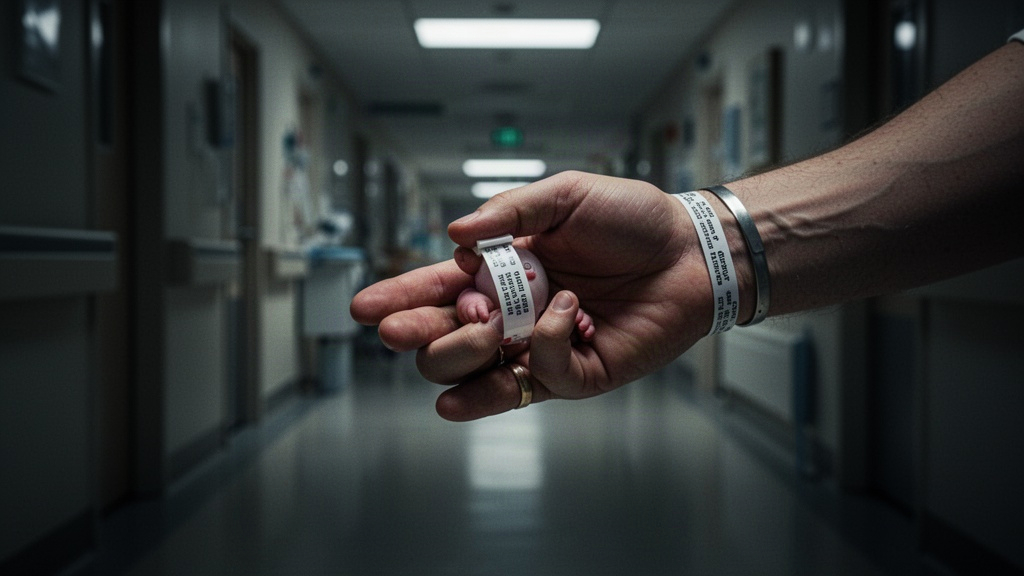
Before any disagreement could escalate, another nurse scanned the newly issued hospital identification band on Lizzy’s arm.
The computer emitted a distinct alerting sound.
She gazed at the display and scanned it once more.
My mother ceased speaking abruptly.
“What is the matter?” I inquired.
The nurse glanced towards the social worker.
“There is an active protective alert registered for this child.”
My father’s face turned deathly pale.
The social worker angled the monitor in my direction.
“Emily,” she stated cautiously, “according to this record, Lizzy was never legally intended to reside with your parents.”
The alert on Lizzy’s medical chart was merely the prelude. Concealed beneath it were details of another hospital visit, a fabricated signature bearing my name, and a report that my parents had somehow made vanish months prior.
My mother reached for the documents.
“This is an error.”
The social worker withdrew them.
“No one is taking Lizzy anywhere until we fully comprehend the circumstances.”
Hospital security personnel arrived.
My father immediately modulated his tone to a softer register.
“We have been providing care for our granddaughter because her mother deserted her.”
Her mother was my younger sibling, Sarah.
Four months earlier, Mom informed me that Sarah had departed the city following “another mental breakdown” and had transferred temporary custody to them.
I had placed my trust in her.
Sarah had ceased responding to my communications.
Now I pondered the reason for this.
The social worker opened Lizzy’s medical records.
Three months prior, Lizzy had been transported to a different hospital after fainting at school.
She had been suffering from dehydration at that time as well, but that wasn’t the catalyst for the alert.
During that encounter, Lizzy communicated to a nurse her apprehension about returning home with my parents.
A Child Protective Services investigator conducted an interview with her.
The report indicated that Lizzy stated her Grandfather occasionally confined her in rooms when she “posed excessive inquiries.”
My stomach churned.
“Why was she returned to their care?”
The social worker regarded me.
“She was not supposed to be.”
Additional documentation had been submitted forty-eight hours later.
One document claimed that I had inspected my parents’ residence and believed Lizzy was secure there.
At the bottom was my autograph.
I had never seen it before.
“That is a forgery.”
My father promptly stated, “You affixed your signature at our residence.”
“No, I did not.”
Then the social worker presented me with another document.
A limited power of attorney purportedly signed by Sarah.
It granted my parents authority over Lizzy’s medical treatment and a restricted financial account established following Lizzy’s father, Aaron Blake, succumbing in a roadside accident the preceding year.
The account contained over $700,000 from a settlement for wrongful death.
My parents had never disclosed its existence.
Law enforcement officers arrived at the hospital.
My mother commenced weeping.
“We only utilized funds for Lizzy’s benefit.”
However, investigators requested immediate access to the account.
Nearly $190,000 had already been withdrawn.
Payments had been allocated towards my father’s mortgage, two credit cards, and a new sport utility vehicle.
Then Lizzy tugged at my sleeve.
“Aunt Emily?”
I knelt beside her.
“Where is Mommy?”
I froze.
“Sweetheart, Grandma informed me that your mother departed.”
Lizzy shook her head.
“No. Grandma takes me to visit her.”
My mother lunged forward.
“Lizzy, cease speaking.”
Security personnel intervened to restrain her.
“Where do you go to see your mother?” I inquired.
Lizzy whispered the name of a rehabilitation center located less than thirty miles away.
I stared at my parents.
Sarah had never left the vicinity.
She had sustained severe neurological impairments in the same collision that fatally injured Aaron and had spent months undergoing rehabilitation.
My parents had circulated the narrative that she had disappeared due to her instability.
The police contacted the institution.
Sarah was alive.
And she had been requesting my presence.
Then the detective listening to the audio feed posed a final question to the nurse.
“Did Sarah ever report any concerns regarding her parents?”
There was a brief interruption.
“Yes.”
“When did this occur?”
“Two months ago. She alleged that they were appropriating funds from her daughter’s settlement.”
My mother collapsed into a chair.
The nurse continued her account.
“However, the complaint was withdrawn after we received a sworn statement from her sister, Emily, indicating that the accusations stemmed from Sarah’s brain injury.”
I felt every gaze shift towards me.
“I never authored such a statement.”
The detective responded calmly, “Then someone has been replicating your signature for a considerably longer period than we initially believed.”
The police separated my parents prior to commencing their interrogations.
That proved to be their initial misstep.
My mother attributed the signatures to misunderstandings. My father claimed Mom handled all the documentation.
Neither account aligned.
By the following morning, investigators had obtained the records that my parents had never anticipated anyone would cross-reference.
Sarah and Aaron’s automobile collision had occurred eleven months prior.
Aaron perished at the scene of the incident.
Sarah survived with a severe brain injury that impaired her speech and memory, but her medical providers expected a substantial recovery.
While she remained hospitalized, my parents offered to assume temporary guardianship of Lizzy.
Then the settlement for wrongful death was issued.
Aaron’s attorney had arranged for the majority of the funds to be held in a secure account for Lizzy until she reached adulthood.
Sarah exercised control over limited withdrawals intended for educational, medical, and basic support purposes.
My father was unable to access these funds.
Unless Sarah became legally incapacitated.
That was the turning point.
My parents began informing medical professionals that Sarah was experiencing confusion more frequently than was actually the case.
They discouraged relatives from visiting her.
They informed me that she had departed rehabilitation against medical advice and had disappeared.
In reality, they relocated her to a different facility and instructed the personnel not to disclose any information to anyone except “authorized family members.”
Subsequently, they fabricated that authorization themselves.
They forged Sarah’s signature on a power of attorney document.
They forged mine on declarations supporting their petition for guardianship.
And when Lizzy informed the school nurse that Grandpa confined her in rooms and that Mommy was still nearby, CPS became involved in the matter.
That action nearly jeopardized their entire scheme.
Consequently, my parents withdrew Lizzy from her school.
They advised neighbors that she had relocated with Sarah.
They submitted my falsified safety statement to undermine the CPS complaint.
Then they kept Lizzy almost exclusively within the confines of the house.
The cupboard became a form of punishment.
Lizzy eventually disclosed to investigators the reason for this.
She had discovered my telephone number inscribed inside an old birthday card. She attempted to contact me using my mother’s phone.
My father apprehended her before the call could be completed.
Following that incident, they commenced confining her in the closet whenever they departed the residence or anticipated visitors.
The contusions on her wrist were a result of her struggle against him that morning.
Law enforcement personnel conducted a search of my parents’ dwelling.
Within my father’s desk, they discovered duplicates of my driver’s license, scanned representations of my signature, records of financial withdrawals, and drafts of documents bearing my appellation.
They also uncovered correspondence that Sarah had written to me.
Eleven such letters were found.
My parents had never dispatched any of them.
One letter read:
Emily, something is amiss. They persistently inform everyone that I am incapable of comprehending financial matters. I possess sufficient understanding to recognize that Aaron’s account is diminishing.
Another letter read:
Please check on Lizzy. Dad becomes agitated when she expresses a desire to visit me.
I wept >so profoundly that I could scarcely continue reading.
Sarah had been endeavoring to contact me for several months.
Two days later, I finally encountered her.
She was more frail than I recalled and walked with the assistance of a cane, but she recognized me instantly.
“Emily?”
I crossed the room and embraced her.
Her initial inquiry was not related to the financial matters.
“Is Lizzy secure?”
“Yes.”
She closed her eyes and began to weep.
The criminal investigation persisted for many months.
Banking records indicated that my parents had withdrawn over $230,000 prior to the accounts being frozen.
My father eventually confessed to falsifying numerous documents.
My mother admitted to knowledge of the fraudulent nature of the guardianship papers and to assisting in concealing Sarah’s whereabouts.
Both individuals faced criminal prosecution related to fraud, forgery, financial exploitation, and child endangerment.
The remaining settlement proceeds were transferred to a trust overseen by the court.
Sarah continued her rehabilitation process.
Until she was capable of safely resuming her full parental duties, I assumed the temporary guardianship of Lizzy under a legitimate court order.
On the first evening she stayed with me, I showed her the bedroom I had prepared.
She stood at the threshold of the doorway.
“You are not going to lock it?”
I swallowed with difficulty.
“No.”
“Even if I behave badly?”
“You are permitted to close it yourself. However, no one will confine you inside.”
She gazed at me for a moment.
Then she wrapped her arms around my waist in an embrace.
Several months later, Sarah had regained sufficient strength for Lizzy to begin spending weekends with her once more.
The three of us kept the hospital wristband that initiated all these events.
Not because Lizzy required a reminder of what transpired.
But because I did.
A single scan had revealed a concealed hospital record.
That record brought to light a falsified signature.
The signature exposed the stolen funds.
And the illicitly obtained money ultimately unveiled the truth that my parents had spent months keeping hidden behind closed doors.
Anzeige
728 x 90